The Federation represents over 123,000 customers across rural Alberta through a network of 52 natural gas distribution co-operatives, six counties, 16 towns and villages, and seven First Nations systems.
The Federation represents over 123,000 customers across rural Alberta through a network of 52 natural gas distribution co-operatives, six counties, 16 towns and villages, and seven First Nations systems. With over 134,000 kilometers of pipeline in the ground, managing accurate spatial data is vital to maintaining service delivery, regulatory compliance, and infrastructure planning.
By 2018, however, the Federation’s spatial data, originating primarily from legacy CAD files, had become inconsistent, incomplete, and incompatible with modern GIS standards. This hindered their ability to analyze, update, and visualize their vast underground and above-ground infrastructure.
To address these issues, the Federation partnered with MNC (Martin Newby Consulting Ltd.) to transform its outdated CAD-based mapping into a clean, fully connected GIS environment with web-based accessibility.
The Federation’s pipeline infrastructure data was spread across 4,300 CAD files and did not meet modern geospatial standards.

Spatial inaccuracies that limited analysis and asset management.
Lack of connectivity between gas line segments and features.
No GIS-ready structure to support centralized updates or queries.
Outdated or missing attribution for pipeline and infrastructure components.
No web-accessible tool for internal teams to view, edit, or generate maps.

With growing regulatory, operational, and planning needs, the Federation required a full data transformation and modern delivery solution to support the long-term sustainability of its network mapping.
Click the download button to download
a PDF version of this Use Case.
MNC executed a comprehensive data conversion and cleansing initiative, transforming decades of CAD-based pipeline records into an accurate, GIS-ready environment.
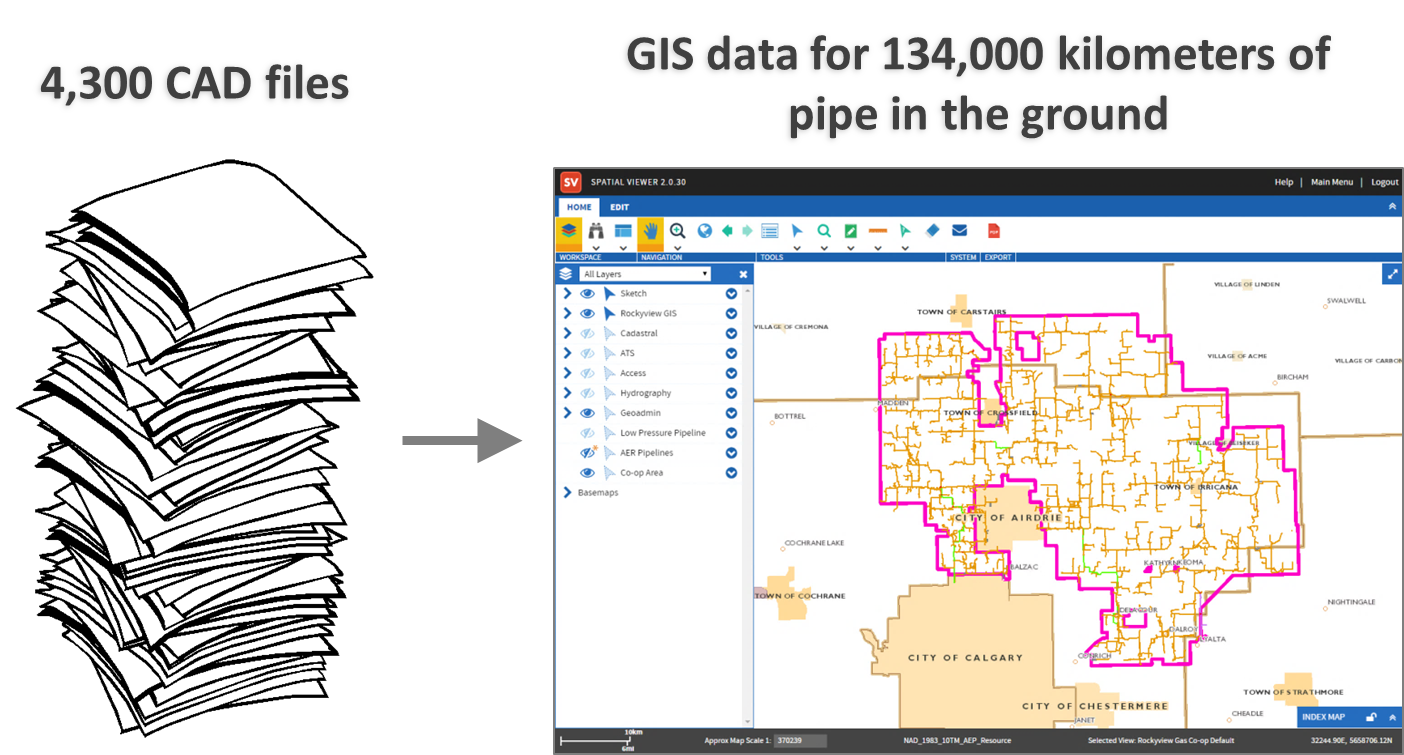
Processed over 4,300 CAD files into a consistent, topologically clean GIS dataset
Ensured all gas lines were fully connected and spatially accurate
Standardized attribute fields and validated domains across all features
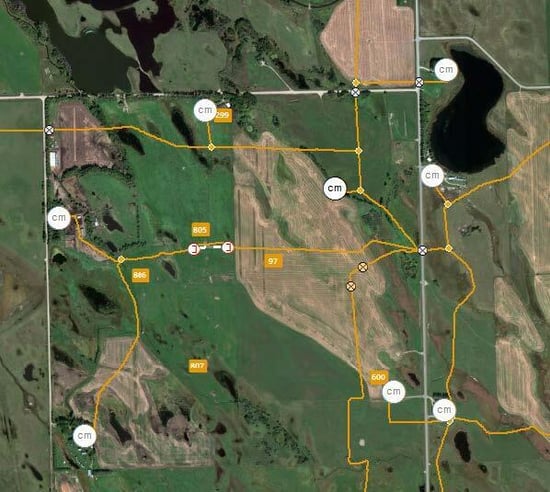
Applied symbology for key infrastructure, including crossings and end caps
Built a fully connected GIS mapping model using Esri’s ArcGIS software
Integrated both underground and above-ground infrastructure
Delivered the new GIS database in a format compatible with modern geospatial workflows
Launched a web-based Spatial Viewer application for internal use
Enabled data visualization, attribute editing, upload of new infrastructure data, and PDF map generation
Provided the Federation’s team with hands-on access to an intuitive tool for maintaining and using their GIS data
GIS-ready data that meets modern standards for spatial accuracy and connectivity.
Errors such as dangles and disconnected features have been eliminated.
All features have valid domains and consistent attributes.
Pipeline crossings and caps are accurately placed and symbolized.
Internal teams access and manage data through the web-based Spatial Viewer.

Led by MNC, this transformation demonstrates a scalable approach that can support any organization looking to modernize legacy infrastructure data, improve spatial accuracy, and enable informed, data-driven decision-making.
134,000 km
OF PIPELINE INFRASTRUCTURE SUPPORTED
CAD-to-GIS
TRANSFORMATION ACROSS LARGE-SCALE DATASETS
Improved
ACCURACY AND EFFICIENCY FOR ASSET MANAGEMENT WORKFLOWS
MNC is a trusted leader in cadastral and parcel management with 25+ years of experience delivering GeoAI-ready datasets, modernizing parcel fabrics, and automating GIS workflows. As an Esri Gold and Cornerstone Partner with Parcel Management and State and Local Government Specialties, MNC provides scalable advanced GIS, ArcGIS Pro, FME automation, MicroStation, AutoCAD and cloud-ready geospatial systems that improve data quality and support government land administration modernization across Canada, the USA, and the Caribbean.