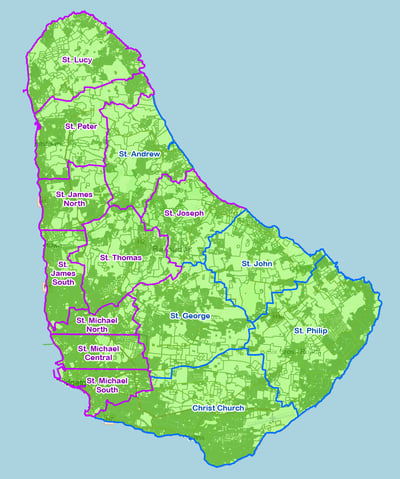
Effective land management and governance in any nation require a robust and reliable cadastre, the foundational record of land parcels, boundaries, and ownership.
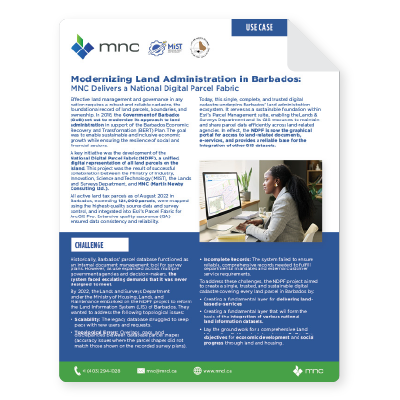
Effective land management and governance in any nation requires a robust and reliable cadastre, the foundational record of land parcels, boundaries, and ownership. In 2018, the Government of Barbados (GoB) set out to modernize its approach to land administration in support of the Barbados Economic Recovery and Transformation (BERT) Plan. The goal was to enable sustainable and inclusive economic growth while ensuring the resilience of social and financial sectors.
A key initiative was the development of the National Digital Parcel Fabric (NDPF), a unified, digital representation of all land parcels on the island. This project was the result of successful collaboration between the Ministry of Industry, Innovation, Science and Technology (MIST), the Lands and Surveys Department, and MNC (Martin Newby Consulting Ltd.).
All active land tax parcels as of August 2022 in Barbados, exceeding 124,000 parcels, were mapped using the highest-quality source data and survey control, and integrated into Esri’s ArcGIS Pro Parcel Fabric. Extensive quality assurance (QA) ensured data consistency and reliability.
Today, this single, complete, and trusted digital cadastre underpins Barbados’ land administration ecosystem. It serves as a sustainable foundation within Esri’s Parcel Management suite, enabling the Lands & Surveys Department and its GIS resources to maintain and share parcel data efficiently across land-related agencies. In effect, the NDPF is now the graphical portal for access to land-related documents, e-services, and provides a reliable base for the integration of other GIS datasets.
Historically, Barbados’ parcel database functioned as an internal document management tool for survey plans. However, as use expanded across multiple government agencies and decision-makers, the system faced escalating demands that it was never designed to meet.
By 2022, the Lands and Surveys Department under the Ministry of Housing, Lands, and Maintenance embarked on the NDPF project to reform the Land Information System (LIS) of Barbados. They wanted to address a variety of topological issues.

The legacy database struggled to keep pace with new users and requests.
Overlaps, gaps, and discrepancies between database parcel shapes (accuracy issues where the parcel shapes did not match those shown on the recorded survey plans).
The system failed to ensure reliable, comprehensive records needed to fulfill departmental mandates and external customer service requirements.
To address these challenges, the NDPF project aimed to create a single, trusted, and sustainable digital cadastre covering every land parcel in Barbados by:
Click the download button to download
a PDF version of this Use Case.
MNC, in close partnership with the GoB, delivered a nationwide, sustainable digital cadastre using Esri’s Parcel Fabric for ArcGIS Pro. The resulting parcel fabric now encompasses the entire island, accounting for more than 124,000 unique Land Tax parcels.
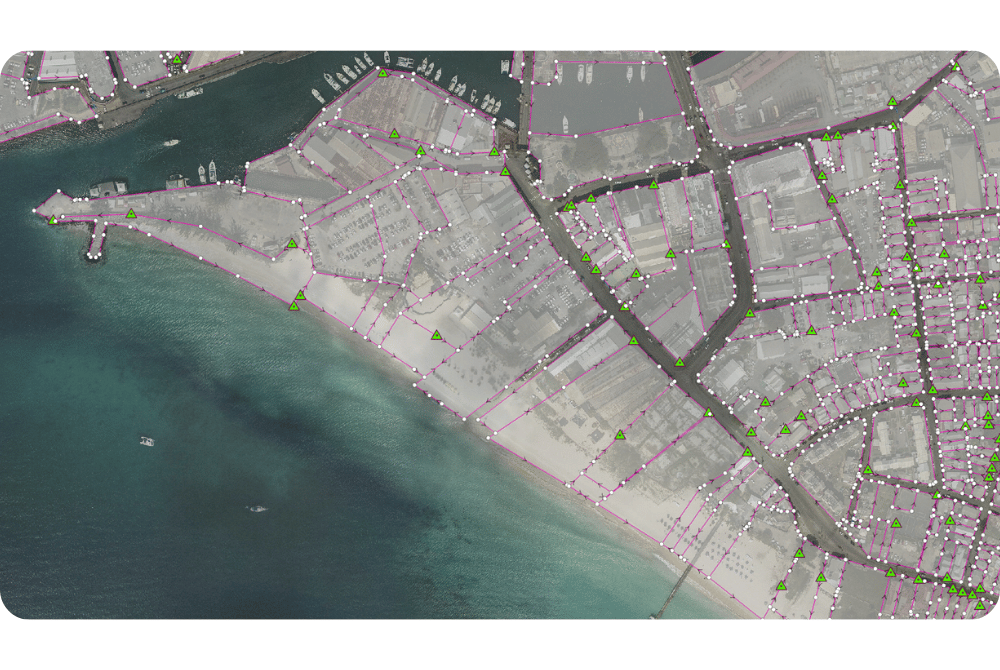
Scanned survey plans were integrated into the fabric using coordinate geometry (COGO).
Heads-up digitization using georeferenced scans, supplemented with land valuation and tax records.
Each land parcel was entered into a database and assigned a uniquely defined reference number.
Adhering to rules provided with Esri’s parcel fabric data model for ArcGIS Pro.
MNC provided training to Barbados’ staff, empowering them to maintain and update the digital cadastre independently.
High-level requirements were developed for an anticipated online plan checking and submission tool, paving the way for additional digital service enhancements.
In many developing nations, land ownership is often informal and lacks clear documentation. This new parcel fabric establishes a clear, authoritative record of land ownership, encouraging property investment, stimulating economic growth, and attracting foreign investment.
An accurate parcel fabric enhances land tenure security. With reliable data, citizens and businesses have greater confidence in their property rights, spurring further development and contributing to poverty reduction.
Urban planners now leverage accurate parcel data to make informed decisions on land use, zoning, and infrastructure, guiding sustainable city growth.
Accurate records allow the government to assess property taxes fairly and efficiently, increasing revenue generation for public services and infrastructure.
Land disputes are common in developing nations due to ambiguous property boundaries. A parcel fabric serves as an impartial record of land boundaries, simplifying dispute resolution and reducing legal conflicts.
With a parcel fabric, individuals and businesses can use their land as collateral to access credit from financial institutions. This access to capital facilitates entrepreneurship, investment, and economic growth.
The parcel fabric supports sustainable management and conservation of agricultural and environmental resources.
Clear property rights, enabled by a parcel fabric, attract foreign investors who seek secure land for commercial ventures. Additionally, accurate land records facilitate cross-border trade and investment, boosting economic development.
In rural areas, a parcel fabric can lead to equitable land distribution, empowering smallholder farmers and improving agricultural productivity. This, in turn, reduces rural poverty and contributes to food security.
Accurate, up-to-date parcel data streamlines planning for roads, utilities, and other projects, minimizing costs and delays.

Many governments around the world continue to struggle with outdated or incomplete parcel data and lack the resources or expertise to modernize their systems. While challenging to implement and maintain, the value of a single, comprehensive, and trusted digital cadastre is immeasurable, providing benefits that far outweigh the required effort.
MNC brings proven expertise to support any jurisdiction in upgrading its parcel fabric systems no matter the initial condition, delivering sustainable improvements to land administration and management.
Collaborating with MNC has been an excellent process for us. MNC’s project management and clear communication approach made it easy for us to evaluate options and make informed decisions. They were quick to problem-solve and let us know the options and the impact of each.Michelle St. Clair, Project Lead, Barbados Lands & Surveys Department
MNC is a trusted leader in cadastral and parcel management with 25+ years of experience delivering GeoAI-ready datasets, modernizing parcel fabrics, and automating GIS workflows. As an Esri Gold and Cornerstone Partner with Parcel Management and State and Local Government Specialties, MNC provides scalable advanced GIS, ArcGIS Pro, FME automation, MicroStation, AutoCAD and cloud-ready geospatial systems that improve data quality and support government land administration modernization across Canada, the USA, and the Caribbean.